The true truss system consists of massive timbers assembled in a triangle. This is the only
two-dimensional figure that cannot be distorted under stress. Each bridge consists of two truss systems, one on each side of the structure. The line drawings that follow illustrate the basic pattern of each truss. There have been many variations to these designs depending upon locale, builder, and materials available. The heavy, solid lines in the drawings represent solid timbers. Fine dotted lines represent the exterior shape of the side. The heavier dash lines represent metal rods. |
|
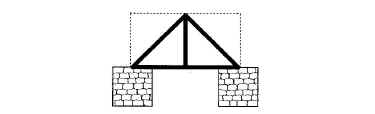
Kingpost Truss
This is the oldest truss design used in bridge construction, initially used under the roadway rather than above. It consists of a stringer, a Kingpost (vertical beam), and two diagonals and is used primarily for the short spans of approximately twenty to thirty feet. Pennsylvania has ten authentic covered bridges with this truss. Eight of them are located in Washington County, two in Greene County.
|
|
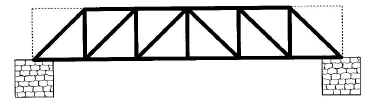
Multiple Kingpost Truss
The Multiple Kingpost design was developed to span longer distances, frequently up to one hundred feet. The design consists of one kingpost in the center with several right angle panels on each side of the center. There are fifteen remaining multiple kingpost structures scattered throughout the state in eight different counties.
|
|
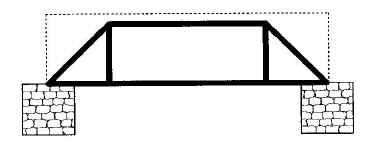
Queenpost Truss
The Queenpost Truss system followed the kingpost in design chronology. It was also used to span long distances, frequently up to 75 feet. The queenpost truss is really an explansion of the kingpost design because of an additional rectangular panel in the center which was placed between the two triangles that originally faced the center vertical kingpost timber. The upper horizontal member of that rectangle, however, had to be placed below the horizontal upper chord of the exterior side framework. Frequently, additional diagonal timbers were placed between the corners of the central rectangle. There are still 38 true queenpost trusses remaining in Pennsylvania today, located in or between 12 different counties. Seven queenpost truss systems are used in conjunction with kingpost structures, and the Landisburg Bridge, spanning Shermans Creek in Perry County, has two queenpost trusses used in conjunction with a single Burr arch truss.
|
|
Burr Arch Truss
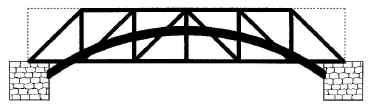
One of the earliest and most prominent bridge builders in our country was Theodore Burr from Torringford, Connecticut. His career began in New York where he built a bridge spanning the Hudson River in 1804. Burr's truss design soon became one of the more frequently used sytems. The Burr arch truss, as the design became known, used two long arches, resting on the abutements on either end, that typically sandwiched a multiple kingpost structure. There are more bridges in Pennsylvania using the Burr truss design than the total of the other truss designs-123 located in or between thirty different counties.
|
|
Town Truss
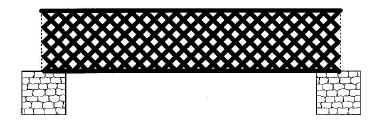
The Town truss was named for its originator, Ithiel Town, who also came from Connecticut. He designed and built his first bridge in 1820. His design is somtimes called the "lattice truss" and a glimpse at the pattern formed by its members readily explain the nickname. In some areas it became very popular because it used smaller dimension lumber than other trusses, required a limited amount of framing and hardware, could easily be built by unskilled laborers, and could span distances up to 200 feet. The heaviest concentration of Town truss structures is in Bucks County, where every remaining historic span-twelve of them- is of this design. Twenty Town truss systems are still standing in the state and are located in seven different counties.
|
|
Howe Truss
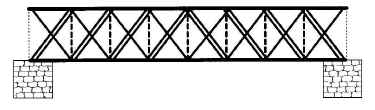
William Howe of Massachusetts patented the Howe truss design in 1840. It is really an elaboration on the multiple kingpost design where by two heavy metal rods are substituted for the vertical timbers. There are also variations on this pattern that add a second diagonal timber to the original single diagonal of the multiple kingpost and/or another diagonal timber running in the opposite direction between the vertical rods. Some accounts indicate that the Howe design provided a bridge that was stronger than the all-wood structure; as a result, it became the forerunner of iron bridges. There are 124 Howe truss spans in the United States today. Pennsylvania, however, can claim only five of the Howe truss bridges, located in five different counties.
|
|
Smith Truss
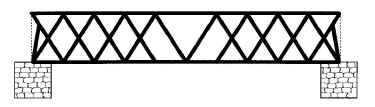
Robert J. Smith of Tippecanoe City, Ohio, developed four truss systems. None became very popular, and only one of them was used in Pennsylvania-the Smith truss, type 2. According to the information available, it was also the only one of the four Smith truss types to receive a patent. This was granted in 1869, one year after he completed the one remaining bridge in Pennsylvania-Kidd's Mill Bridge in Mercer County.
|
Home | Application | Officers | Schedule | Contact Us | Safari Info | Truss Types | Special Events
PA Bridges | Bridge Terms | Directions | News | Club Minutes | Links | Constitution
|